Exercise
09 Mar 2024
The effect of recovery techniques on muscle damage, soreness, fatigue and inflammation after exercise
Recovery techniques can be an important tool for maximising performance and preventing the performance losses that follow intense exercise. This article presents the results of a meta-analysis that comprehensively examines the impact of several recovery techniques on markers of muscle damage, soreness, fatigue and inflammation.
In this meta-analysis, 99 studies met the inclusion criteria, involving 1,188 participants and 106 experimental groups.
General conclusions:
Massage appears to be the most effective technique for reducing delayed onset muscle soreness (DOMS) and perceived fatigue.
Cold water immersion and compression garments also showed significant benefits for DOMS and fatigue.
Active recovery — low-intensity exercise after an intense session — also appears to help reduce delayed onset muscle soreness. This may be explained by improved blood flow in muscle tissue, which facilitates the removal of metabolic waste and may contribute both to a lower likelihood of injury and to reduced delayed soreness.
Stretching and electrostimulation, by contrast, appear to have no significant positive effect.
In this article we will focus only on the first three: massage, cold water immersion and compression garments.
Effects of massage on muscle recovery:
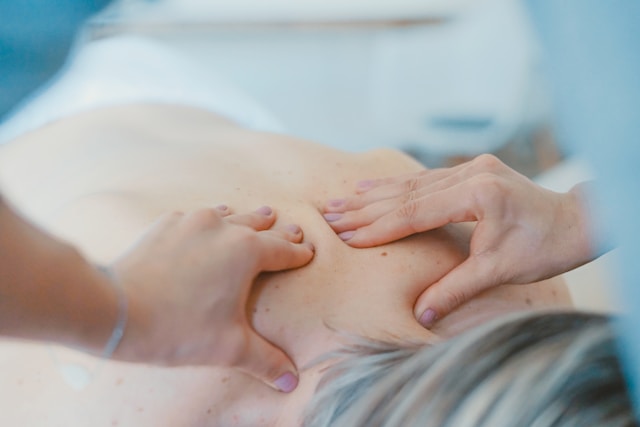
Massage appears to be the most effective recovery technique for reducing delayed onset muscle soreness (DOMS) and perceived fatigue after exercise. Several physiological mechanisms are involved:
Improved blood and lymphatic flow: massage improves blood and lymphatic circulation, promoting the removal of metabolic waste and reducing swelling and oedema. This can relieve muscle soreness.
Reduced inflammation: massage is associated with lower blood concentrations of creatine kinase (CK) and interleukin-6 (IL-6) after exercise, indicating reduced muscle damage and inflammation. By reducing inflammation, massage can help accelerate muscle recovery and reduce the risk of muscle damage.
Improved muscle function: massage can help restore muscle function after exercise by reducing muscle tension and stiffness. That can improve range of motion, flexibility and overall performance.
Specific benefits of massage for DOMS and fatigue:
Reduced DOMS: massage has been shown to significantly reduce DOMS, the muscle soreness and stiffness that typically occurs 24-48 hours after exercise. Massage can relieve DOMS by reducing muscle damage and inflammation.
Reduced perceived fatigue: massage also appears to significantly reduce perceived fatigue after exercise. This is likely due to its capacity to improve blood flow, reduce inflammation and improve muscle function.
Cold water immersion for muscle recovery
Water immersion, particularly in cold water, is a technique used to promote muscle recovery after exercise.
Cold water immersion (CWI) has a significant effect on reducing delayed onset muscle soreness and perceived fatigue. Earlier research, including meta-analyses, has shown that CWI can effectively reduce delayed onset muscle soreness even up to 96 hours after exercise when compared with passive recovery. It also tends to reduce perceived fatigue, an effect observed across a range of sporting contexts. Optimal conditions for CWI involve water temperatures between 11°C and 15°C for 11 to 15 minutes after exercise.
Several mechanisms explain the benefits of CWI, including its capacity to reduce exercise-induced inflammation and muscle damage. It has a positive impact on blood creatine kinase (CK) concentration, although the effect size is modest. Factors such as immersion depth and water temperature play a crucial role in reducing oedema and the sensation of pain after intense exercise. In addition, hydrostatic pressure assists fluid transport, while cold-induced vasoconstriction reduces inflammation and pain.
Vasoconstriction from the cold may also reduce fluid diffusion into the interstitial space and locally dampen the inflammatory reaction, which in turn can reduce the sensation of pain. Cold on its own also has a direct analgesic effect.
Compression garments
Compression garments for muscle recovery:
Compression garments are specialised clothing designed to apply controlled pressure to the body, promoting circulation and reducing muscle fatigue and soreness.
Improved blood flow: compression garments can improve blood circulation in the affected area, promoting the removal of metabolic waste and delivering oxygen and nutrients to the muscles. That can reduce muscle fatigue and soreness.
Reduced swelling and oedema: the pressure applied by compression garments can help reduce swelling and oedema in the muscles, relieving pain and improving mobility.
Improved muscle support: compression garments support the muscles, reducing muscle vibration and fatigue. That can improve muscle performance and prevent injury.
Specific benefits of compression garments for DOMS and fatigue:
Reduced delayed onset muscle soreness: compression garments appear to have a positive influence on reducing DOMS, particularly when worn during or immediately after exercise, thanks to their capacity to improve blood flow and reduce swelling.
Reduced perceived fatigue: compression garments may also help reduce perceived fatigue after exercise, likely because they improve muscle support and reduce muscle vibration.
The beneficial effects of compression garments on DOMS and perceived fatigue may be attributed to the reduced space available for swelling and oedema under the compression applied to the limb, and to better venous circulation.
No significant changes were observed in CK, IL-6 or CRP concentrations following the use of compression garments after exercise.
Some discrepancies across study results may be explained by differences in study protocols, including recovery periods, pressure applied and the location of the compression.
We close this article with the authors' own conclusion:
"In summary, we identified several recovery techniques that can be used after a single exercise session to induce a reduction in delayed onset muscle soreness (DOMS) and/or perceived fatigue. Among them, massage appears to be the most effective for both DOMS and perceived fatigue. Water immersion and compression garments also have a significant positive impact on these variables, though with a less pronounced effect.
Perceived fatigue can be managed effectively using compression techniques such as compression garments, massage or water immersion. Furthermore, the most powerful techniques for recovery from inflammation are massage and cold exposure, such as water immersion and cryotherapy. In this meta-analysis, only a single recovery session was examined. Further research should be conducted to obtain a clearer picture of which recovery techniques best suit athletic performance.
It is important to know whether similar results are obtained when the same recovery technique is used regularly after exercise. In addition, studies combining several recovery techniques should be carried out to investigate whether synergistic effects occur."
Dupuy, O., Douzi, W., Theurot, D., Bosquet, L., & Dugué, B. (2018). An Evidence-Based Approach for Choosing Post-exercise Recovery Techniques to Reduce Markers of Muscle Damage, Soreness, Fatigue, and Inflammation: A Systematic Review With Meta-Analysis. Frontiers in physiology, 9, 403. https://doi.org/10.3389/fphys.2018.00403